 Dana O'Driscoll
 By Dana Driscoll (100% human written, errors and all! 🙂 )
My first experience with plant medicine was with my grandfather, George Custer, who would take my cousins and me into the woods to go foraging for food and medicine. We would go down the mountain and into the deep forest behind our house, and he showed us American Ginseng (Panax quinquefolius), Woodland Nettle (Laportea canadensis), black birch (Betula lenta), ramps (Allium tricoccum), and Sassafras (Sassafras albidum). These were not plants he learned from any book—these were plants taught to him by his own family members, this generational knowledge passed on. He taught by taste, smell, and lived experience—he didn’t know the Latin names or the chemical constituents, but he knew that if you were run down and needed energy, a cup of Ginseng root or leaf tea would support you, and he knew how to make traditional sassafras root tea that helped “thicken” the blood in the fall. What grandfather was doing was taking a very localized, bioregional approach to wild foods and herbal wisdom. Many years later, I am so grateful that I got to spend these years with my grandfather in the woods, giving me a foundation in the herbalism I still teach to this day. What my grandfather was doing was a form of ancestral herbalism—he was passing knowledge the same way he learned it, and that knowledge spans countless generations of humans through many millennia.
In today’s article, we’ll explore the concept of bioregional herbalism—as a core feature of herbalism we teach and practice—at the Pennsylvania School of Herbalism. We’ll explore how this rooted, localized herbalism is uniquely suited to the challenges of today’s age, and how it can be empowering to help people and planet.
What is bioregionalism?
Bioregionalism is a broader idea that all systems (political, economic, cultural) are more sustainable, humane, and just if they are organized around naturally defined bioregions. Bioregions are geographic areas that have relatively consistent patterns of flora, fauna, and ecosystems as well as distinct cultural identities and shared human stories. Within a bioregion is an ecoregion, a smaller building block which focuses primarily on the ecological and natural features of regions and the beings that live there: a region that is similar in flora (plants and trees), fauna (animals, insects, amphibians, fish, birds, reptiles, etc), features of soil, climate, geology, in the same watershed region, and other environmental features. Ecoregions are nested—we start at the smallest unit—a patch of forest behind your home, and move into larger areas, watersheds, and so forth. Bioregionalism is inherently place-based, recognizing that if we can create modern human communities rooted in more regional ecosystems and cultures, we can create more sustainable interaction with nature and each other.
Bioregionalism’s appeal is that it helps us think about local systems—local foods, local medicine, local community, and our local needs and put them at the forefront of our practice. By sourcing locally and building community, we create a resilient practice that is rooted in our landscape. The alternative to bioregionalism would be globalism, where we can purchase herbal ingredients from the far reaches of the globe—but this practice largely disconnects us from our place-based wisdom and introduces some other issues.
Why Bioregional Herbalism?
Bioregional herbalism is an embodied, ancestral, and localized herbal practice where we craft herbal medicines in a regenerative way that connects us to our local ecosystem and each other. This herbal practice is rooted in the abundant medicines of where we live. This is the medicine of nature right outside your door. If we apply the principles of bioregionalism to herbalism, we end up with a number of features, challenges, and strengths, which I’ll now identify.
Features and Strengths
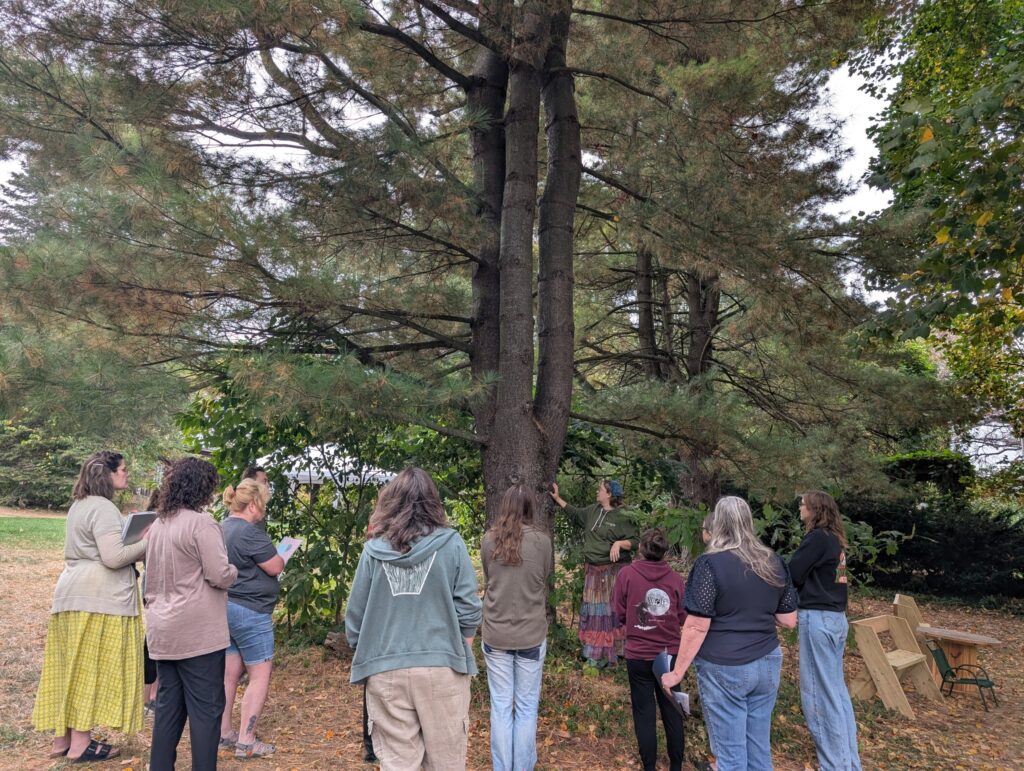
Connected. One of the strengths of bioregional herbalism is that it is an inherently connecting practice—it allows us to connect to the land where we live, connect to other people who care about that land, and build community. There is nothing so joyful as going out into the garden or forest for a few hours with people to see what is growing there.
Ancestral. Bioregional herbalism is an embodied herbal practice that uses the same methods for teaching plant wisdom that our ancestors did: oral teachings, direct observation, interaction with nature, and sustaining and regenerative practices for tending and monitoring the health of our lands for future generations. This allows us to learn better and to honor the ancestors of our blood and the land where we live.
Embodied. By learning local plants and experiencing them where they grow, you can deepen your herbal knowledge tremendously. On the side of identification and preparation, you understand what the plant looks like, where she grows, how she looks when she is freshly dried or prepared, what she should smell like, taste like, and so on. But on the side of the medicine itself, you know the effect of the fresh plant on your body, mind, and spirit. This creates a deeply embodied herbalism, where you are using not only your brain but your senses to learn.
Resilient. Resiliency is the idea of being able to adapt to change and adversity and to persist through difficulty. Learning herbal medicine helps you cultivate resilient skillsets that allow you to depend less on broader economic and capitalistic systems that no longer serve the bulk of humanity—by creating practices that are separate from those systems.
Affordable and accessible. Many people are currently taking up the practice of herbal medicine because modern healthcare is becoming less and less accessible and affordable, but the plant medicines are abundant and available. It is incredibly empowering to access what you need to stay healthy right outside your door or grow those plants in your garden!
Rooted in nature. Bioregional herbalism, rooted in local place, requires us to attend to our relationship with the land in a very different way. Our ancient ancestors were careful stewards of the land, depending on their local land for everything, and engaging in regenerative practices that ensured that future generations would also be able to harvest food and medicine. As we begin to make this return to our local land, we learn not only about individual plants and their medicine, but also how to connect much more deeply with our local ecosystem and become part of that ecosystem.
Empowering. The knowledge and wisdom that you gain from practicing bioregional herbalism empowers you. You don’t have to worry about grocery store shelves going bare, or things being out of stock or unaffordable. You can simply go into the land, harvest what you need, and take control of your own health.
Adapted to local needs. When you start wildcrafting herbal medicine, one of the things you quickly learn is how nature always puts the cure to an ailment next to the very thing that can cause difficulty! For example, Japanese Barberry harbors mice in the winter, which increases tick populations—but also has berberine-rich roots and lower branches that help fight Lyme. Poison Ivy and Jewelweed grow right next to each other.
Challenges
If the above sounds fabulous, it is! But this approach to herbalism does have some challenges.
Requires local wisdom and teachers. Not all regions or areas have people who have preserved herbal knowledge or have good knowledge of local plants, and it can be tough to find people well-versed in the herbs that grow where you live. In fact, my own herbal education was cut short on both sides of the family by the untimely death of both my grandfather and grandmother on the other side, both of whom held the knowledge. It wasn’t until I met Jim McDonald in Southeast Michigan that I found a person who could teach me locally-rooted herbalism. And even then, I had to adapt that herbal knowledge and add many new plants when I came back to Pennsylvania. Since there were very few people teaching this knowledge here in Western and Central PA, this is one of the reasons we started the Pennsylvania School of Herbalism. There are many people who are on their own, and it is hard to learn this embodied wisdom from apps, books, or YouTube.
Not all local medicinal plants are well-studied or described in herbal books or the scientific literature. Many books on herbalism cover the same plants—the garden plants, the most accessible and common ones from Europe that everyone uses. There are also often popular medicinal plants, but I have found that a lot of the plants that are the most abundant where I live are not often covered or have very minimal coverage. My solution to this has been to seek out other folks who practice herbalism where I live, talk to them, and also do extensive research to find more information. You’ll find surprising information in older books, so keep your eyes open. A good example of this, where I live, is Spicebush (Lindera benzoin) and Sneezeweed (Helenium autumnale), which has very little coverage in broader herbalism and is so abundant and medicinal!
Requires access to wild land. For people in cities, bioregional herbalism is challenging due to being surrounded by a largely toxic, human-built environment and limited access to wild places. Places that may be wild in cities are often places that you don’t want to harvest (by railroad tracks, under bridges). Thus, it is harder to practice this kind of herbalism depending on where you live. Other issues of access might be transportation-related, where many people in cities do not have personal vehicles and may have difficulty getting to more remote harvesting locations. There are still amazing ways to practice bioregional herbalism, but they require overcoming these access challenges.
Slow. In a fast-paced world, we have expectations for how long things take. When you start learning bioregional herbalism, you realize that this is slow knowledge and slow medicine. While you can literally start making medicine within minutes of going outside, to do it well, you need to slow down, become rooted and observant, and really start to learn.
Bioregional Herbalism as Earth Care
I want to spend more time discussing one aspect of the strengths—that of being rooted in nature, connected, locally-adapted, and resilient. Herbalism classes come in many shapes and sizes. One common and very accessible format are online classes with pre-recorded content—these were few and far between before the pandemic but now are quite common as many herb schools produced them during the pandemic. While there is nothing wrong with these kinds of classes (we learn from them too) they are often structured in a way that has minimal or no interaction with others or with one’s ecosystem. They are classes that focus on the knowledge of herbalism—knowledge of the head, using commercially available plants that may not be local but that are easy to purchase. What you miss with these is both deepening your connection to the earth as well as the lived sensory experience—knowledge of the body of being an herbalist. And most importantly, these kinds of classes often disconnect you from the nature outside of your door. When most of your interaction with herbs are those found in plastic packages, grown and harvested somewhere unknown, and then shipped with fossil fuels to your door—there are already several layers of disconnection between you, the land that produced that plant, and the plant herself.
When we practice bioregional herbalism, that commercial exchange is instead replaced with rootedness, connection, and care. As you begin to learn the medicines of your local ecosystem, you learn not only where they grow and what they look like, but where they are abundant or struggling. You begin to monitor the populations of the plants you use—either abundantly harvesting them to ensure that opportunistic species do not take over, or spreading seeds to ensure more abundance of native species. You become part of the ecosystem and learn how to tend and inhabit the ecosystem just like your ancestors did. This creates a deeply connected practice where you learn how to care for both people and planet.
This matters deeply in the age of the Anthropocene, where human-caused activity is destroying habitat, causing the 6th mass extinction of life on the planet, and destabilizing the climate. By learning how to build a relationship that is reciprocal, mutual, and regenerative, you are able to become a force of good and protect the same plant populations that will heal and nourish you.
Bringing together the Mind, Body, Heart, and Spirit
Ultimately, bioregional herbalism is part of a broader holistic herbal practice that we teach here at the Pennsylvania School of Herbalism. We root our knowledge in the local and abundant plants in our region, in understanding how humans who lived where we lived have used those plants over time, and how we build relationships with those plants to help both people and planet. Bioregionalism gives us a guide to decide what we teach, how we teach, where we teach, and how the ecosystem where we live is at the center of herbal practice.
If you are interested in seeing our bioregional herbalism classes in practice, you can join us for one of our for wildcrafted medicine intensives—the first one taking place on May 30th, 2026 here.