
The Pennsylvania School of Herbalism offers three certificates:
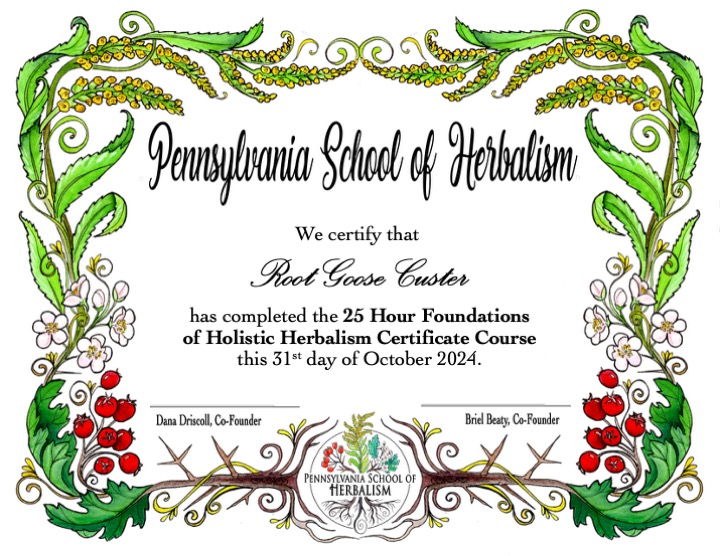
- 25 Hour Foundations of Holistic Herbalism Certificate. This certificate is earned after finishing our five-month, 25-hour Foundations of Holistic Herbalism course (we offer in-person and hybrid options).
- 50 Hour Holistic Herbalism Certificate. This certificate is completed with an additional 25 hours of herbalism classes in our six areas (see below)
- 100 Hour Holistic Herbalism Certificate. This certificate is completed with 100 total hours (50 hours above the holistic herbalism certificate program, including additional classes in our six areas, clinical skills, formulation, advanced energetics, apothecary development, and mentoring)
- If you have previous herbal experience and are looking to jump directly into our 50 or 100 hour program and bypass the Foundations course. You can apply for that here. Please note there is a $30 application fee for this.
Our Holistic Herbalism Certificate is designed to provide a thorough introduction to the major areas of herbalism and allow students to gain confidence in their growing herbalism practice. We teach holistic herbalism which emphasizes the mind-body-spirit connections of health and healing. Our certificate also teaches bioregional methods of honoring and working with your beautiful, local landscape including sustainable harvesting, wild tending, and reverent growing practices. We emphasize locally-based herbalism that focuses on the plants, trees, and mushrooms that grow in the wild or can be grown in gardens in Pennsylvania and northeastern North America more broadly. Individuals who are interested in the certificate program can contact us for more information and to discuss their specific interests. The first 5 lines of credits represent credit hours earned for those taking the Foundations Course.
Schedule and Timeline
Any of our Holistic Herbalism Certificates are designed to be completed on a flexible timeline. Students may begin with any class but all should plan on taking our Foundations of Holistic Herbalism intensive early in their studies, which offers a thorough introduction to the six areas of herbalism that we teach. Opportunities for one-on-one mentoring and apprenticeship are also available on a limited basis. Our certificate program is flexible and allows you to take classes with us in areas that you are interested in while also allowing you to receive a foundation in holistic herbalism.
Each of our three certificate programs builds on the other (eg. you get the 25 hour, then the 50 hour, then continue to the 100 hour if you choose). The 50 and 100 hour certificates allow you to build a practice of holistic herbalism that is rooted in our local bioregion with plants, trees, and mushrooms right outside your door.
Holistic Herbalism Certificate Program Areas of Study
We offer instruction in the following areas in our certificate program:
- Energetics and Body Systems: The first foundation of herbalism is understanding the human body and providing a systematic way for making observations about the human body. Students learn the traditional Western herbalism system of energetics, which includes a person’s broader constitution and the qualities of the system or imbalance.
- Materia Medica and Herbal Actions. Materia Medica refers to the study of specific plants and mushrooms and their healing and interaction with the human body, mind, and spirit. Students learn a wide range of plants and their healing properties, including the ways that plants act upon the body. We place a considerable emphasis on bioregional plants that can be grown or wild foraged in Pennsylvania, emphasizing opportunistic plant use.
- Medicine Making. Holistic Herbalism includes a wide range of preparations of plants, including making salves, tisanes, tinctures, infusions, decoctions, floral waters, essential oils, infused oils, herbal steams, compresses, smokes, steams, baths, soaks, liniments, poultices, and many others. Students learn a wide range of plant preparations and how to choose appropriate preparations in a hands-on way.
- Stewardship and Identification. As our Holistic Herbalism Certificate program includes a specific emphasis on plants and mushrooms local to Pennsylvania, and builds reciprocal relationships with nature. We offer many opportunities to get out in our local ecosystem or in the Rhoneymeade garden to learn about plant identification, sustainable harvesting, wildcrafting, rewilding and spreading seeds, and planting and growing herbs. We also teach medicinal mushrooms, mushroom identification and foraging, and opportunistic (invasive) plant medicine.
- Formulation & Clinical approaches. A final area our Holistic Herbalism Certificate covers is how to holistically evaluate a person and their needs and create specific herbal blends of herbs for healing and well-being. This includes holistic herbal clinical skills and herbal formulation, including creating and managing an herbal apothecary.
Holistic Herbalism Certificate Program: 25 Hour Certificate
The 25-hour Certificate is earned upon the completion of our in-person or hybrid Foundations of Holistic Herbalism course. This course offers an introduction to all aspects of herbalism and is designed for beginners or those who want to deepen their herbal practice. You can learn more about this course here.
- Energetics and body systems: 6 hours
- Materia Medica and Herbal Actions: 7 hours
- Medicine Making: 6 hours
- Stewardship and Identification: 3 hours
- Formulation and Clinical Approaches: 3 hours
50 Hour Certificate
The 50-hour certificate program is a continuation of our 25-hour certificate. The 50-hour program allows you to select electives in the following:
- Energetics and body systems: 4 hours minimum (10 hours)
- Materia Medica and Herbal Actions: 4 hours minimum (10 total)
- Medicine Making: 4 hours (11 total)
- Stewardship and Identification: 5 hours (8 total)
- Formulation and Clinical Approaches: 4 hours (7 total)
- The remaining 5 hours can be filled in a category of your choosing.
At the conclusion of the 50-hour certificate, you will complete an herbal reflection project and have a 1:1 mentorship meeting with Dana or Briel, which will help you set goals and continue your herbal journey beyond the certificate program.
Download our Course Tracking PDF or Word Document for full details of the 50-hour curriculum, a tracking sheet and information on the capstone.
100 Hour Certificate
The 50-hour certificate program is a continuation of our previous certificates and represents an additional 50 hours of instruction. In this program, we offer advanced instruction and mentorship in clinical skills and a clinical group consultation course, creating and using your home apothecary, herbal formulation, a deeper dive into Traditional Western Herbalism energetics, and also offer 1:1 and small group mentoring to help you continue to build your knowledge and confidence. The core courses are:
- Creating and Using Your Home Apothecary (3 hours)
- Advanced Herbal Apothecary mentorship (3-4 hours; 1:1 or small group discussion about expanded uses of home apothecary)
- Clinical Group Consultation (5 hour course; small group clinical herbal discussion with other students in the class)
- Holistic Herbalism Intensives (8 hours); we will offer sets of advanced courses 2-3x a year for half-day or full-day instruction. These classes will rotate and will focus on advanced herbal energetics, building confidence in clinical and formulation skills, and expanding your knowledge of available plants with materia medica deep dives
- Individual or small group mentorship, advanced apothecary mentorship, and herbal support experiences (3-4 hours)
You can again select electives in these categories: (totals represent the number, including the 50 hour certificate)
- Energetics and body systems: 4 hour minimum (total 14 hours throughout the certificate program)
- Materia Medica and Herbal Actions: 4 hour minimum (total 15 hours)
- Medicine Making: 4 hour minimum (total 14 hours)
- Stewardship and Identification: 4 hour minimum (total 12 hours)
- Formulation and Clinical Approaches: 4 hour minimum (total 11 hours)
The remaining 12 hours can be in any areas of your choosing. (total choice credits 16 hours)
At the conclusion of the 100 hour certificate, you will create a portfolio that demonstrates your growing herbal practice and will have an opportunity to share it with other students in the school.
Download our Course TrackingPDFor Word Document for full details of the 100-hour curriculum, a tracking sheet and information on the capstone.

