 Dana O'Driscoll
 By Dana O’Driscoll, Pennsylvania School of Herbalism. 100% human written and human-created.
Herbalism is a practice rooted in our senses—in what we taste, smell, feel—and how those experiences have medicinal value. Think about your experiences in walking through a garden—stopping to smell the intoxicating scent of the roses, breathing in the lavender flowers, sniffing lemon-scented geranium leaves, or gathering some oregano for cooking. Smelling these and other aromatic plants calms the mind, relaxes the body, gladdens the heart, and lightens the spirit. And these aromatic scents—made up of volatile or essential oils from the plants—have deep medicinal value and a wide range of herbal preparations.
What are Aromatics?
In the traditional Western Herbalism, aromatics—along with bitters, demulcents, astringents, relaxants, and stimulants—are considered “foundational” herbal actions. An herbal action refers to the effect that the plant may have on the body, mind, or spirit. A “foundational” action—including the six above are herbal actions that are both easily discernible with your senses and have observable and noticeable effects on the body. These six foundational herbal actions align with the energetic patterns that are present in the body, mind, and spirit. For example, you can smell the fragrant volatile oils of aromatics, or your lips pucker when you taste an astringent.
Aromatic herbs are abundant in our ecosystem here in Pennsylvania, both in the garden and in the wild. When you walk through the wild areas, certain times of year—especially when the roses are blooming—you can literally scent them on the breeze. These are herbs that we can easily smell when crushed, burned, steeped in tea, etc. A great example of aromatics are garden herbs like rosemary, oregano, sage, or wild medicinals like monarda—all of these plants have a strong scent. In nature, these oils may be used for plants to attract pollinators, defend against insects, regulate growth, or protect the plant from temperature extremes. In the human body, the plant
One of the primary medicines of aromatic herbs is in the volatile oil (or essential oil) that is present throughout in the whole plant. Essential oils represent this oil in a highly concentrated dose—these isolated oils work differently on the body than whole plant medicine or even can throw the body out of balance. While we recognize some great uses for essential oils, we prefer whole plant medicine for most of our preparations, and thus use isolated essential oils sparingly. Aromatic plants have many other medicinal chemical constituents, too, and we get all of their benefits when we use the whole plant of medicine.
Medicinal Features of Aromatic Plants
Aromatic plants often have some common features that are shared as a general principle across most aromatics. Some aromatics may have other medicinal qualities, or have targeted qualities on specific areas of the body.
- Aromatics are dispersive. Many aromatics work specifically on conditions that are stagnant (damp conditions), such as sinus congestion, clouded thoughts, or a sluggish digestive system. They help get things moving again. Good plants for this action include mint (for the GI), lavender (for the mind and muscles) and rose (for the mind and body).
- Aromatics are carminative. Many aromatics have a carminative effect, meaning that they sooth the gastrointestinal tract (GI) by reducing gas, indigestion, pain and cramping, and aiding in a healthy digestion. Good aromatic plants for this action include chamomile, mint, ginger, and catnip.
- Aromatics are anti-microbial, anti-fungal, and anti-viral. Many aromatics have an anti-microbial action on the body due to their terpenoid content, which offers a range of support to fighting bacteria and viruses in the body. Some aromatics need tissue contact for the anti-microbial action, while others are broad-spectrum. Good plants for this action include oregano, thyme, peppermint, and rosemary.
- Aromatics are anti-inflammatory. Many aromatics also have strong anti-inflammatory action, and they often act to inhibit certain inflammatory chemicals and mitigate oxidative stress in the body. They can be used topically or internally for this purpose. Good plants for this action include chamomile, lemongrass, and ginger.
- Aromatics often act as relaxants or anti-spasmodics. Certain aromatic plants may have an affinity or specific action on the nervous system, the digestive system, the musculoskeletal system and so forth. Some aromatics can be both relaxant and stimulating, in the way that a good massage might be (such as mint!).
- Aromatics often act as diuretics. That is, they increase the output of urine as they are processed by your kidneys, which helps keep your entire urinary tract system healthy and free of stagnation or infection.
A good deal of recent scientific research confirms the medicinal content of aromatics is not only confirms this list above but also provides some promising expansions. For example, Grigore-Gurgu, Dumitrașcu, and Aprodu, (2025) provide a comprehensive overview of the medicinal compounds aromatic plants in the Lamiaceae family (which includes oregano, mint, sage, rosemary, basil, and thyme). mint, sage, rosemary, basil, and thyme). These plants possess a high amount of bioactive phytochemicals, which have antioxidant, antimicrobial, and carminative properties. In studying sage, Martins et al. (2015) note that the medicinal content of basil was highly impacted by the kind of extraction and environmental factors. New research is also exploring the use of aromatic herbs for preventing Type II diabetes (Graza, et. al. 2024); as neuroprotective agents (Faridzadeh, 2022) and for supporting healing from coronaviruses (Boukhatem and Setzer, 2020). These are just some of the exciting new avenues explored by science to expand our understanding and use of aromatic herbs.
Aromatic Herbal Preparations
Aromatic herbalism is a very joyful part of the practice of herbalism, as there are many different preparations that you can make, including some that may not be as common. Here is a list of some preparations that take advantage of the aromatic qualities of herbs:
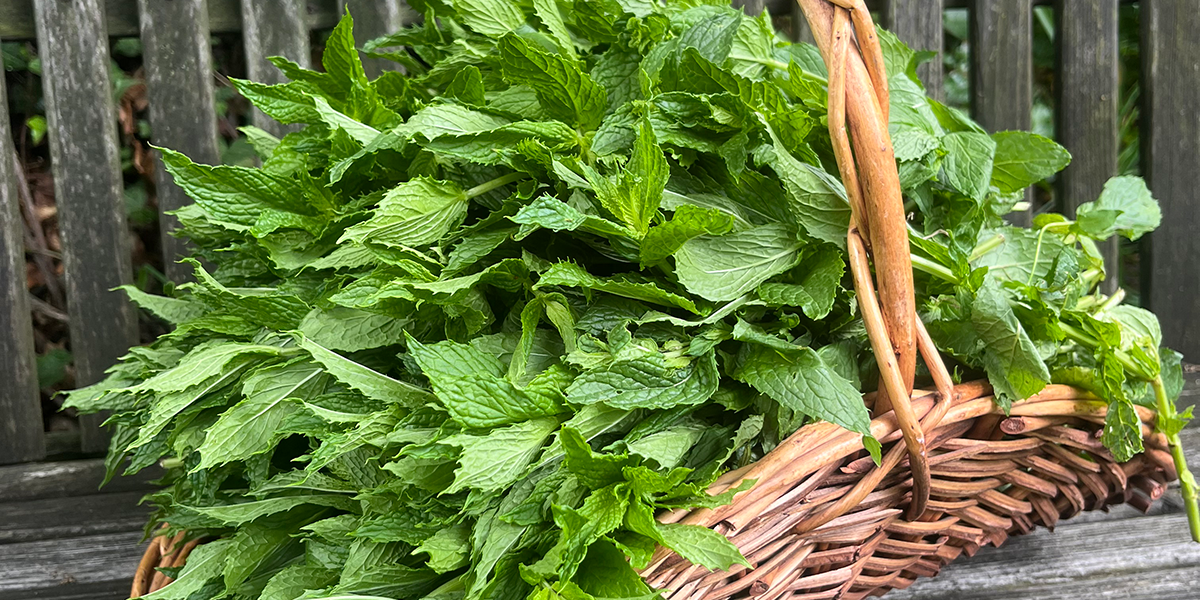
Teas (typically infusions). Teas are one of the best herbal preparations for aromatics. For flower or leaf matter, you want to do a medicinal infusion by boiling water, removing the water from the heat, stirring in your plant, putting on a lid, and waiting 10 minutes. Adding the lid traps the essential oils—and thus, much of the medicine—in the pot. If you have harder plant matter, like sassafras roots or spicebush twigs, you can combine the plant matter with water, bring to a boil, boil 5-10 min with the lid on, and then let it cool. Aromatic plants make teas taste great, and due to their many medicinal actions, are always good to add to a tea blend! My favorites are lemon balm, catnip, lavender (in small quantities), and mint.
Herbal Steams. When you are congested in the lungs and sinuses or need to break up mucus, you can do an herbal steam. Bring a few cups of water to boil, add herbs, put a lid on it for 5-7 minutes, then the steam is ready. You can breathe it in directly (put a towel over your head, gently lift the lid, breathe in the steam. You can also go into a small shower, close the door, and simply sit with the steam. My favorite aromatic herbs for this are eucalyptus (you can grow this in your garden), monarda, New England Aster (especially fresh or dried flower), lemongrass, thyme, and oregano. To encourage coughing, mullein leaf can also be added and is generally recommended.
Salve making. This is one of my favorite ways to capitalize on aromatic herbs—by infusing them in oil and adding beeswax. Aromatic herbs, on their own, can create some incredible smells—experiment with plants that smell good, and try different combinations. A few of my favorite aromatic herbal ingredients are St. John’s Wort, White Pine needle, Rose, and Ground Ivy.
Essential Oils and Hydrosols: The most concentrated form of aromatic oil is found in essential oils. Essential oils are made when large amounts of plant matter are steam-distilled, and the water and oil are separated in the distillation. Lavender is one of the richest essential oil plants, and it still takes about 10-15 lbs. of lavender for a single ounce of essential oil. On the opposite end of the spectrum, an ounce of rose essential oil takes about 200-250 lbs. of rose petals. You can make your own essential oils (in extremely small quantities with high volatile oil plants) and hydrosols using an alembic (still) or even on your stove with several pots. Good plants to experiment with this include any conifer (Eastern Hemlock, Norway spruce, or White Pine are good choices), mint, and lavender.
Aromatic Herbal Bath. One of my favorite ways to use aromatic herbs is to go into the garden in the warm months and gather up aromatic herbs intuitively, adding them to my outdoor or indoor bath. You can also create a sachet of herbs and tie them in a bundle. Add essential oils to Epsom salts for a nice soak. Or, create a strong herbal tea and pour it into the bathwater. Most garden aromatics work wonderfully for this, and my favorites include lemon balm, mint, and monarda.
Medicinal Herbal Incense. A much less common preparation—but one very dear to my heart, is the medicinal herbal incense. Globally, we have incense traditions of burning herbs and resins to help sick people heal, relax those in pain, and also prevent the spread of airborne illness. While traditional incense crafting plants, resins, and trees have become globally endangered (with plants like Frankincense, Copal, Sandalwood, Aloeswood, and Palo Santo all on the ICUN list), we can use local plants to great effect. There are plants, resins, and woods—and even some mushrooms—that are abundant in Pennsylvania that make outstanding incense. Some of my favorites are Mugwort, Lavender, Eastern white cedar, any sage, and Chaga mushroom (using ground and spent chaga after you have brewed it 7-10 times for tea).
Herbal Smoking Blends. Some people enjoy smoking but do not want to smoke tobacco. Other people are trying to quit. Herbal smoking blends can be made for a number of purposes, including helping someone quit smoking cigarettes. Good tasting herbal smoking blends combine aromatic herbs with astringent herbs (strawberry, raspberry leaf, dried apple leaf, staghorn sumac leaf). Good aromatics include skullcap, damiana, lavender, and Mugwort.
As you can see, the world of aromatics is a large part of herbalism. Aromatic plants and trees are some of the most beloved plants and trees in the world, with thousands of years of partnership with humanity. These plant allies offer us not only a wide spectrum of medicine, but allow us to explore a wide variety of plant preparations and really expand our herbalism practice.
Aromatic Herbalism Weekend with the Pennsylvania School of Herbalism
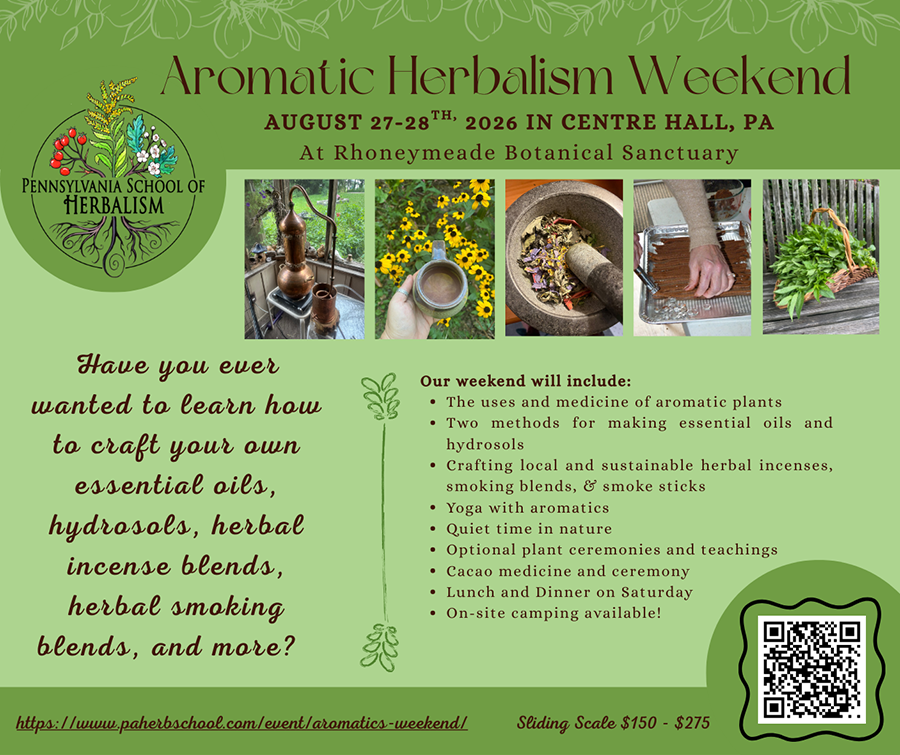
This year’s Pennsylvania School of Herbalism retreat weekend is our “Aromatic Herbalism” weekend, taking place August 28th – 29th, 2026 at Rhoneymeade Arboretum near State College, PA. In this weekend, we will explore some of the less common preparation methods of aromatics, including two different approaches to essential oils and hydrosols (using the kitchen pot method and alembic method), herbal smokes, and medicinal herbal incenses, among other workshops and opportunities. The following is a link for more information and a graphic that provides an overview of our exciting weekend!
References
Boukhatem, M. N., & Setzer, W. N. (2020). Aromatic Herbs, Medicinal Plant-Derived Essential Oils, and Phytochemical Extracts as Potential Therapies for Coronaviruses: Future Perspectives. Plants (Basel, Switzerland), 9(6), 800. https://doi.org/10.3390/plants9060800
Faridzadeh, A., Salimi, Y., Ghasemirad, H., Kargar, M., Rashtchian, A., Mahmoudvand, G., Karimi, M. A., Zerangian, N., Jahani, N., Masoudi, A., Sadeghian Dastjerdi, B., Salavatizadeh, M., Sadeghsalehi, H., & Deravi, N. (2022). Neuroprotective Potential of Aromatic Herbs: Rosemary, Sage, and Lavender. Frontiers in neuroscience, 16, 909833. https://doi.org/10.3389/fnins.2022.909833
Garza, M. C., Pérez-Calahorra, S., Rodrigo-Carbó, C., Sánchez-Calavera, M. A., Jarauta, E., Mateo-Gallego, R., Gracia-Rubio, I., & Lamiquiz-Moneo, I. (2024). Effect of Aromatic Herbs and Spices Present in the Mediterranean Diet on the Glycemic Profile in Type 2 Diabetes Subjects: A Systematic Review and Meta-Analysis. Nutrients, 16(6), 756. https://doi.org/10.3390/nu16060756
Grigore-Gurgu, L., Dumitrașcu, L., & Aprodu, I. (2025). Aromatic Herbs as a Source of Bioactive Compounds: An Overview of Their Antioxidant Capacity, Antimicrobial Activity, and Major Applications. Molecules (Basel, Switzerland), 30(6), 1304. https://doi.org/10.3390/molecules30061304
Martins, N., Barros, L., Santos-Buelga, C., Henriques, M., Silva, S., & Ferreira, I. C. (2015). Evaluation of bioactive properties and phenolic compounds in different extracts prepared from Salvia officinalis L. Food chemistry, 170, 378–385. https://doi.org/10.1016/j.foodchem.2014.08.096