 Dana O'Driscoll
 Herbalism is older than recorded history. The intertwined history of humanity and plants is woven into our DNA, into the very systems of our bodies, interwoven into our brains, our physical bodies, our gut, our minds, and our spirits. We can see this from the most ancient of archeological evidence – the Tassili mushroom figures painted on cave walls in Africa 9000 years ago to the a host of archeological evidence depicting early uses of plants as healig agents here in North America. Another example is the Siberian Ice Maiden (Princess Ukok) 2500 years ago buried with coriander and cannabis, with obvious signs that she had been using cannabis to treat multiple debilitating conditions, including breast cancer. Meanwhile, Otzi the Iceman, who also lived about 5500 years ago, was found with birch polypore and fomes fomentarius mushrooms, along with birch bark baskets, berries, and ferns. As we can see from these and countless other historical examples stretching into pre-history, humans and natural healing, such as plants, trees, and mushrooms, have evolved together.
However, as human technologies and industrialization grew—particularly over the last few centuries, many human beings have become very disconnected from the earth and the healing and wisdom the earth provides. Knowledge of not only how to harvest plants and produce medicine, but also how to engage in stewardship and reciprocation with the land has been largely lost to many people living in a modern world. Now, we attempt to find healing in sterile doctor’s offices and in pills encased in plastic and produced in ways that are disconnected from that broader ecosystem. And many of us feel that lack–and it is because of this disconnection that many are once again turning to herbalism as a practice of reconnection: reconnecting to our own health, to the land around us, to nature’s wisdom, and to our own ancestral legacy of working with plants growing in our local ecosystem. And in doing so, you will discover the same thing that our ancient ancestors did: our local ecosystem offers everything we need to be balanced, healthy, and whole.
Herbalism—at least the kind of herbalism we practice at the Pennsylvania School of Herbalism–is not simply about using nature to heal. Herbalism is about learning how to once again be human beings who are deeply connected with the land around us—to be good stewards of that land, to have wisdom of that land, and to learn how to both take what we need and offer back that same level of healing. As plants will show up again and again to heal us, we can show up to help heal and support our ecosystem in whatever ways we can.
This brings me to two core practices that I see that are critical for learning the kind of locally-based herbalism that we teach and practice: learning how to be a good steward of the land around you (which could be your own land or local land more broadly) and learning how to engage in reciprocal practices, rooted in deep wisdom, that support both your needs and the needs of the land. When you look at the Pennsylvania School of Herbalism’s 50-hour certificate program, you will see that we require 10-15 hours of Stewardship and Identification. By stewardship, we mean taking responsibility for the ethical care of the land where you live, and seeking to protect the health and overall ecosystem of those lands for the good of all beings. By reciprocation, we mean the act of mutual exchange, where you create a balanced relationship with individual plants and the broader ecosystem, where you give back as much as you take.
The great news is that the practice of herbalism—particularly wildcrafted, locally-based folk herbalism–offers many opportunities for doing just this. You can start immediately, and you can build your own knowledge over time. Here are some of the ways that you can start to build stewardship and reciprocation into your own herbalism practice.
Foundational Practices: Building Herbal Wisdom to Preserve and Protect Local Ecosystems
What I call “herbal wisdom” is the knowledge and practices that our ancient ancestors had, and this is the knowledge that will help preserve and protect our ecosystem for future generations. This is the knowledge of how to be a good steward: how to monitor one’s direct impact on the ecosystem and engage in practices that support healthy medicinal plant populations and a healthy ecosystem. For the practice of herbalism, this can be reflected in a lot of different ways. Consider the following questions:
- What a healthy ecosystem looks like and what should be growing and living there. What plants are native? Naturalized? Which plants are opportunistic (invasive)?
- How can you use medicinal harvesting practices to help the ecosystem?
- What changes in your own ecosystem are you observing over time?
Core to answering these two questions is understanding the impact of different plant populations: what is native, what is at risk, and what is opportunistic (invasive) and monitoring those plant populations, using and harvesting more opportunistic and abundant plants, and protecting and preserving the plants that are native, slow to grow, or represent full-plant harvests. A good way to learn this is by reviewing the United Plant Savers “Species at Risk List” as well as exploring Pennsylvania’s Invasive Species List.
(Below: Autumn Olive,Elaeagnus umbellate. This is a plant with a bad reputation that is a wonderful food and medicine, containing high amounts of lycopene, which is a powerful antioxidant that helps prevent cancer, reduces LDL cholesterol, and decreases the risk of heart disease–among many other medicinal uses!)
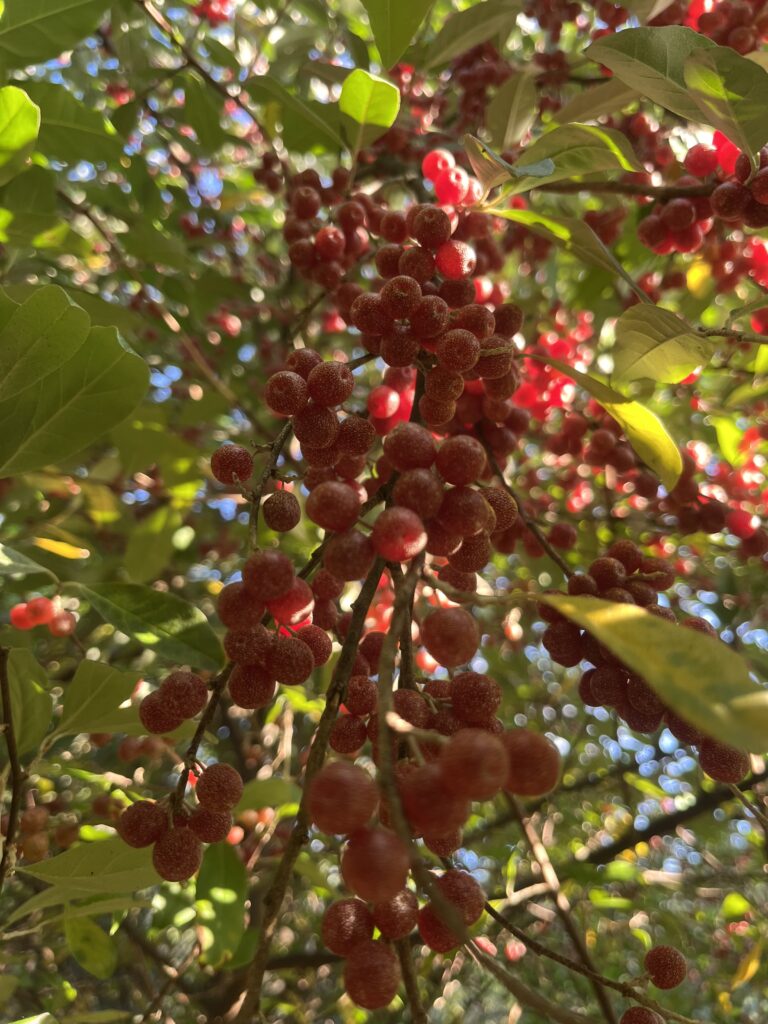
Learning to use the plants that are very abundant in your ecosystem is a great way to engage in stewardship and reciprocation. These plants can never be overharvested, and harvesting them—as much as possible—creates space for other plants (native species) to thrive. In Western and Central Pennsylvania, some of our medicinal opportunistic plants are:
- Japanese Barberry (Berberis thunbergia)
- Japanese Knotweed (Fallopia japonica)
- Common Burdock (Arctium minus)
- Yellow / Curly Dock (Rumex crispis)
- Mutiflora Rose (Rosa multiflora)
- Ragweed (Ambrosia artemisiifolia)
- Garlic Mustard (Alliaria petiolata)
- Autumn Olive (Elaeagnus umbellate)
- Greater Celandine (Chelidonium majus)
- Japanese spirea (Spiraea japonica)
- Mugwort (Atremesia vulgaris)
- Purple Loosestrife (Lythrum spp.)
These plants should be the foundation of everyone’s materia medica and offer a wide range of healing opportunities.
Practices for Your Own Land
If you are on your own land and are growing herbs or would like to grow herbs, consider how you can be a good steward and create a healthy and vibrant ecosystem. This can include:
- Exploring practices that foster a healthy soil-web (lasagna gardening/sheet mulching, no-till approaches, leaning into perennials)
- Fostering biodiversity, particularly for pollinators, amphibians, birds, and other animals. Recognizing that these beings also have a right to live on the land where you do and developing healthy relationships with them.
- Avoiding conventional approaches to land management and seeking alternative, holistic approaches (e.g,. reducing fossil fuel use, eliminating the use of pesticides and herbicides, etc.).
- Educating people who you live with on these best practices.
- Recognizing that many herbal medicines also have many good functions in the ecosystem for habitat, nectar, pollen, and more.
The healthier the ecosystem where you grow your herbs, the more medicinal your plants will be. And the healthier you will be as a result.
Practices for the Land Around You
Many herbalists also forage in public or private lands more broadly for plant and mushroom medicine. You can also practice being a good steward of the lands where you live more broadly through:
- Cleanup. A simple way of giving back to the land that anyone can do is to bring a trash bag and pick up trash as you go through wild areas.
- Seed scattering. Using your knowledge of which plants should be protected, return to plants when they are producing seeds, gather seeds, and then scatter them to new areas.
- Transplanting plants. If you see native plants that are not going to survive where they are growing (such as in public areas, driveways, places where they will be mowed), transplant them to other areas where they can thrive and grow.
- Monitor at-risk populations. Pay attention and note where at-risk species are growing. Examine over a period of years to see if the species are growing or lessening in population.
Stewardship as a Mindset
Ultimately, all of us can learn to be good stewards of the land, helping to protect, preserve, and heal the land for future generations. We can all develop herbalism practices that are reciprocal, that give back more than we take, and in doing so, cultivate deeper relationships with nature, the source of healing. More than anything else, these practices require us to pause, to pay attention, and to remind ourselves of our role in this ecosystem—to be good stewards. To be part of the ecosystem, and to do good.
For those who are interested in a deep dive into these practices, Dana will be offering a class on June 9th, 2025 on “Introduction to Wildcrafting and Herbal Foraging: Ethics, Medicine Making, and Plant and Mushroom Identification,” taking place at Blue Spruce County Park in Indiana, PA.
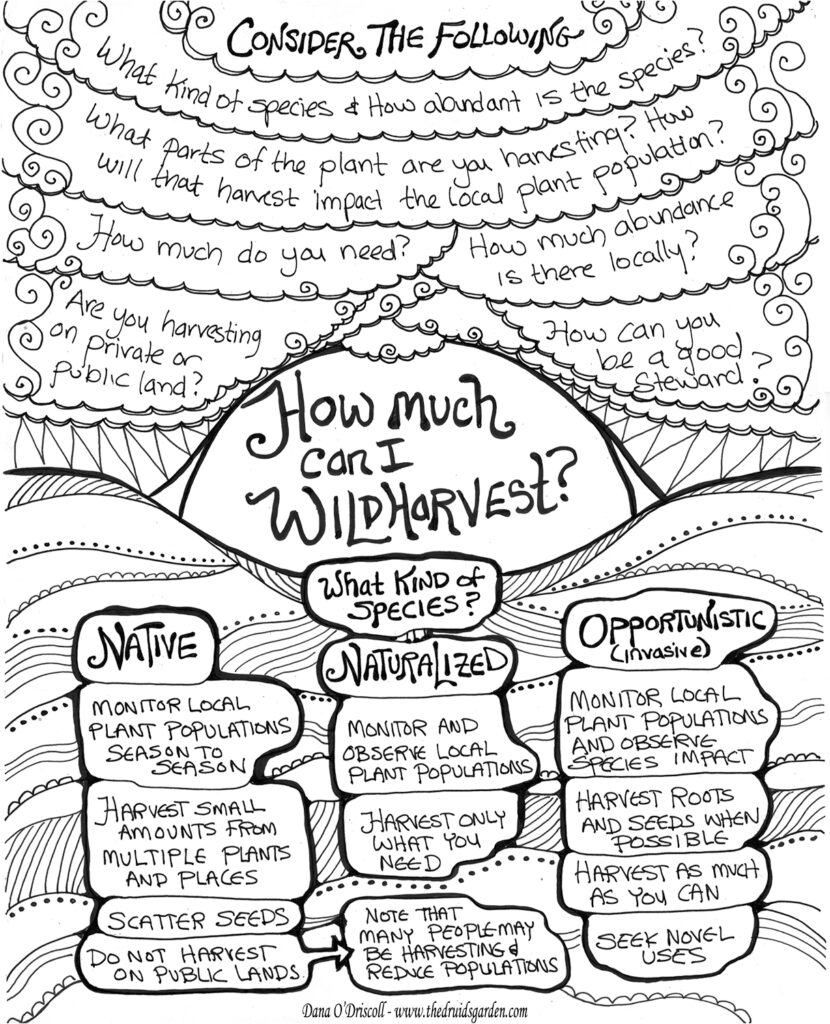
Coloring Book Page
Here’s a page from Dana’s forthcoming Herbalism for Everyone coloring book that discusses these concepts in an easy-to-understand format.